
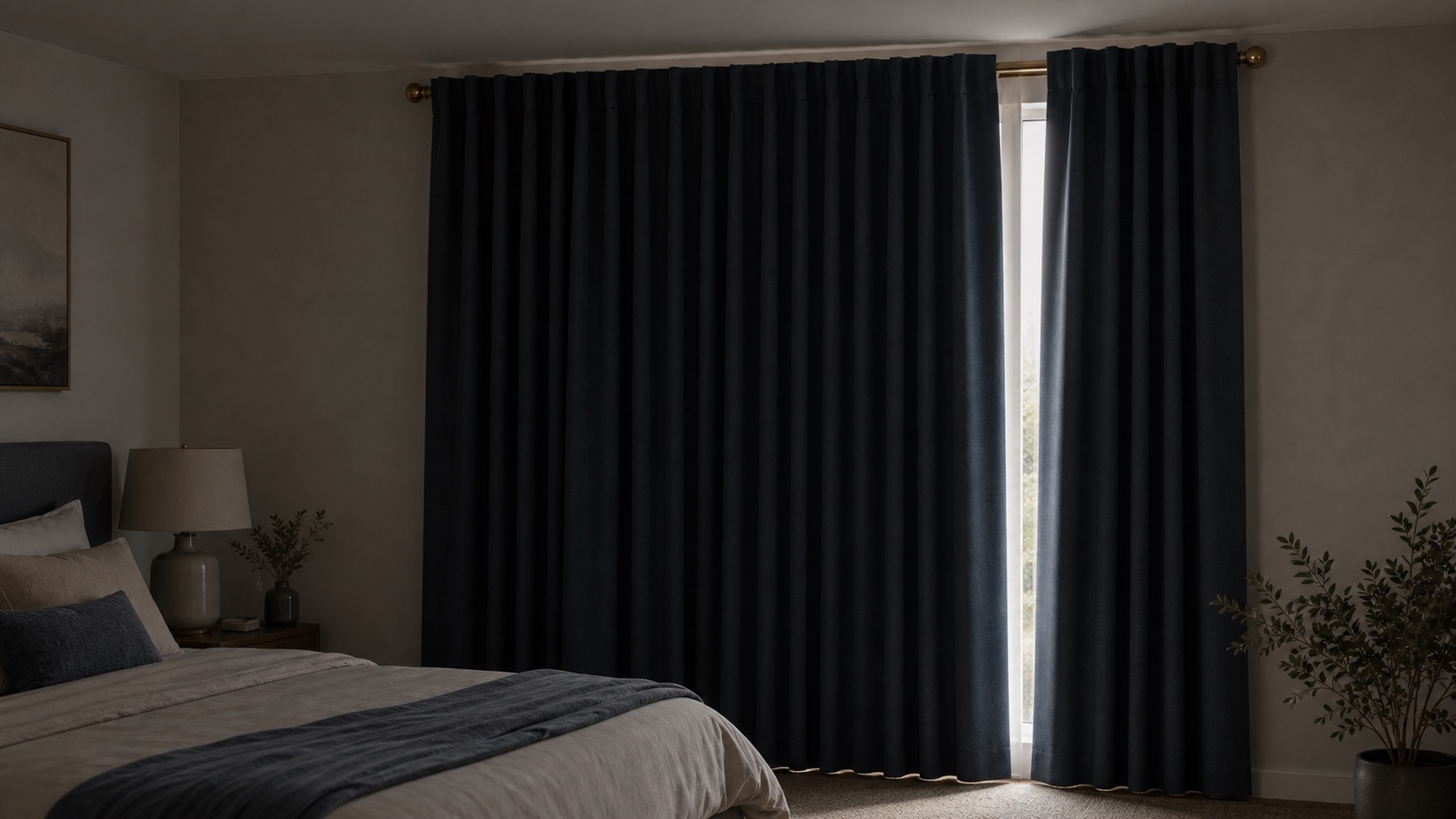
Blackout curtains are not only about fabric. A good blackout fabric can still let light leak around the sides, top, center, and bottom if the measurements are too tight. Privacy works the same way. The panel may be opaque, but a narrow rod, shallow return, or weak center overlap can leave sightlines into the room.
For functional curtains, measure for coverage first and style second. The goal is to make the curtain larger than the glass in the places where light and sightlines escape, while still leaving enough room for the fabric to move.
Start with the light path
Stand in the room during the brightest part of the day and look at the window edges. Light usually leaks in five places: the left side, the right side, the top above the rod, the center where panels meet, and the bottom near the floor or sill. Each gap points to a different measuring decision.
Side gaps are often caused by a rod that does not extend far enough beyond the trim. Top gaps are usually caused by mounting the rod too low or using hardware that sits far away from the wall. Center gaps happen when the panels are too flat, too narrow, or do not overlap when closed. Bottom gaps happen when the curtain is too short for the selected finish.
| Problem | Measurement to revisit | Practical fix |
|---|---|---|
| Light at the sides | Rod width and side extension | Extend rod beyond the frame and allow fabric to cover trim |
| Light at the top | Rod height and bracket projection | Mount higher or use a track/return style closer to the wall |
| Center gap | Panel count and fullness | Add fabric width or choose panels that overlap more naturally |
| Bottom glow | Finished drop | Use kiss, slight break, or a carefully measured sill finish |
Measure wider than the glass
For blackout curtains, using the bare glass width is usually too tight. The curtain needs to cover the window, trim, and a little wall space beside the frame. This side coverage reduces light leaks and makes the curtain feel more private from outside.
When planning new hardware, enter the window width plus side extension into the calculator. If the rod already exists, measure the rod span. If the current rod is barely wider than the window and the room still leaks light, the problem may be the hardware width rather than the panel width.
Consider returns and wraparound hardware
A return is the distance from the front of the curtain back toward the wall. Traditional drapery planning uses returns and overlaps to control how fabric closes at the edges and center. For ready-made blackout curtains, you may not be designing custom returns, but the principle still matters: a curtain that sits far away from the wall leaves more side light.
Wraparound rods, ceiling tracks, or wall-close tracks can reduce side gaps because the fabric turns back toward the wall. If you use standard decorative rods, wider side extension and more fabric can help, but they may not block light as tightly as return-style hardware.
Use enough fullness, but do not overfill the stack
Blackout fabric is often heavier than sheer or unlined fabric. Too little fullness creates gaps and a flat, strained appearance. Too much fullness can make the curtain bulky, hard to slide, and difficult to stack away from the glass. A practical starting range is often around 1.8x to 2.2x for ready-made blackout panels, then adjust for fabric weight and rod width.
If the curtain is mainly for sleep, prioritize closure. If the curtain is mostly decorative and rarely closed, you can use a lower fullness ratio or a lighter lining. If the curtain opens every morning and closes every night, make sure the stack-back area is wide enough for the fabric to gather without fighting the brackets.
Length choices for blackout curtains
For floor-length blackout curtains, hover can leave a thin line of light at the bottom, especially if the floor is uneven. Kiss length usually blocks more light while still looking clean. A slight break can close the bottom gap more forgivingly, but it may collect dust and can be awkward around heaters or doors.
For sill-length blackout curtains, be careful with the bottom edge. A panel that stops exactly at the sill may still leak light if it swings forward from the glass. Inside-mounted shades behind curtains can help when true darkness is required.
Layering sheer and blackout curtains
Layering can improve daytime privacy and nighttime darkness, but it changes the hardware measurement. A double rod or double track needs enough projection for two layers to move without rubbing. The sheer layer often uses more fullness because it is light and translucent. The blackout layer can use slightly less fullness if the fabric is heavy, as long as it still closes with overlap.
If you layer panels, calculate the blackout layer for functional coverage first. Then calculate the sheer layer separately if it uses a different rod, track, panel width, or fullness ratio.