
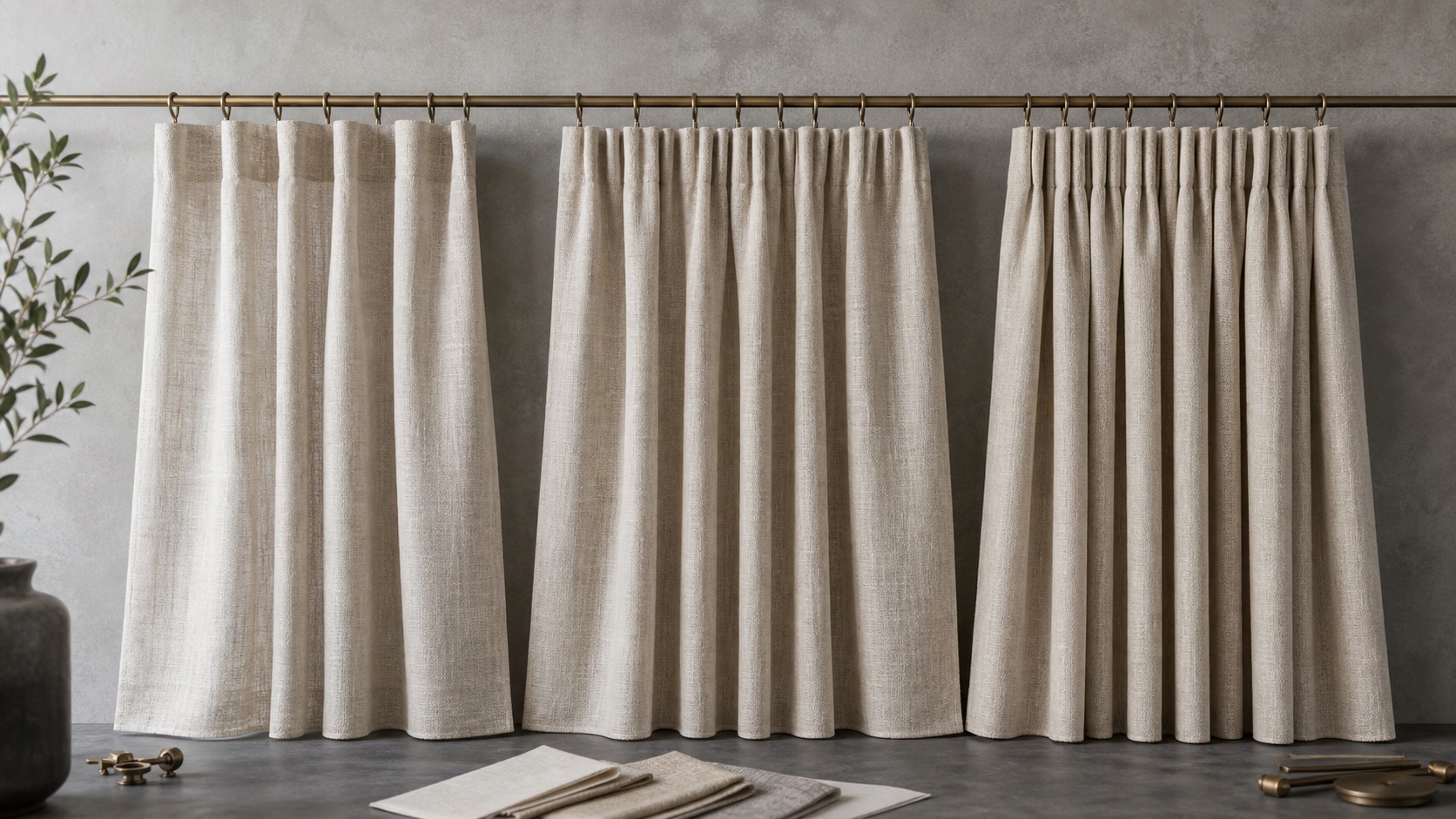
Fullness is the difference between a flat piece of fabric and a curtain that looks like a curtain. It is the extra width that forms folds, hides gaps, and keeps panels from looking stretched across the rod. In calculation terms, fullness ratio compares the total flat fabric width with the rod or track width.
A 2.0x fullness ratio means the flat fabric is about twice the width of the area it covers. If the rod span is 76 inches, 2.0x fullness asks for about 152 inches of flat fabric. The curtain will not look 152 inches wide on the wall because the extra material folds back and forth.
The basic formula
The core calculation is simple:
Total flat fabric width = rod or track width x fullness ratio
Then the panel count is calculated from the width of one ready-made panel:
Panels to buy = total flat fabric width / width of one panel, rounded up
Rounding up is important. If the math says 2.4 panels, you cannot buy 0.4 of a ready-made panel. Two panels would be too skimpy, so the practical answer is three panels.
| Fullness | Visual result | Often works for |
|---|---|---|
| 1.2x to 1.4x | Very flat, minimal folds | Utility spaces, thick fabric, temporary panels |
| 1.5x | Clean and modest | Small windows, heavy blackout fabric, budget-sensitive rooms |
| 2.0x | Balanced, gathered, ready-made friendly | Most bedrooms and living rooms |
| 2.5x | Fuller and softer | Sheers, tall windows, formal rooms, wide rods |
| 3.0x or more | Luxurious, dense folds | Very light fabric, custom drapery, decorative treatments |
Why 2.0x is a useful default
Many consumer curtain guides point people toward roughly double width because it is a practical middle ground. It gives enough fabric to create folds without making the curtain bulky or expensive. For a simple grommet, eyelet, rod pocket, or back-tab panel, 2.0x fullness usually looks intentional in an everyday home.
That does not mean 2.0x is always correct. A thick lined blackout panel can feel bulky at 2.5x. A very thin sheer may look weak at 1.5x because light passes through it and exposes the sparse folds. Pinch pleat, wave track, and custom headings may also need their own fullness assumptions because the heading style controls how fabric stacks.
Panel count examples
Imagine a 72-inch rod and a ready-made panel width of 52 inches.
| Fullness | Fabric width needed | Panels at 52 in each | Practical result |
|---|---|---|---|
| 1.5x | 108 in | 2.08 panels | Buy 3 panels |
| 2.0x | 144 in | 2.77 panels | Buy 3 panels |
| 2.5x | 180 in | 3.46 panels | Buy 4 panels |
This example explains why panel count does not always change when you move the slider slightly. A 72-inch rod still rounds to three 52-inch panels at both 1.5x and 2.0x. The extra fullness appears in how gathered those three panels feel, not necessarily in a different package count.
Fullness affects coverage, not only decoration
Fullness is often described as a style choice, but it also affects function. Curtains that are too flat can pull open at the center, reveal side gaps, and show the window shape too clearly. Curtains with enough fabric overlap more naturally and are easier to close without stretching the heading.
For blackout curtains, fullness needs balance. Too little fabric creates light leaks at the center and sides. Too much heavy fabric can be hard to move and may crowd the stack-back area. For sheers, more fullness can improve privacy because the folds layer the fabric.
How stack-back changes the calculation
Stack-back is the space the curtain occupies when open. If you are planning a new rod, adding stack-back to both sides increases the rod width, and that larger rod width increases the fabric width needed. This is not a mistake. It is the tradeoff that lets the curtain clear the glass when open.
For example, a 60-inch window with 8 inches of side extension on each side becomes a 76-inch rod. At 2.0x fullness, the fabric target is 152 inches. If you skipped side extension and used only the 60-inch glass width, the fabric target would be 120 inches, but the open curtains would block more of the window.
When to reduce or increase fullness
Reduce fullness when the fabric is heavy, the rod space is tight, or the window is narrow and the curtain will be opened often. Increase fullness when the fabric is sheer, the room is formal, the window is tall, or the curtain will stay mostly closed and needs a softer wall of fabric.
For ready-made curtains, there is also a practical compromise: the available panel widths may force a little more or less fullness than your ideal number. That is normal. A calculator gives the target, then the buying decision chooses the closest workable set of panels.