
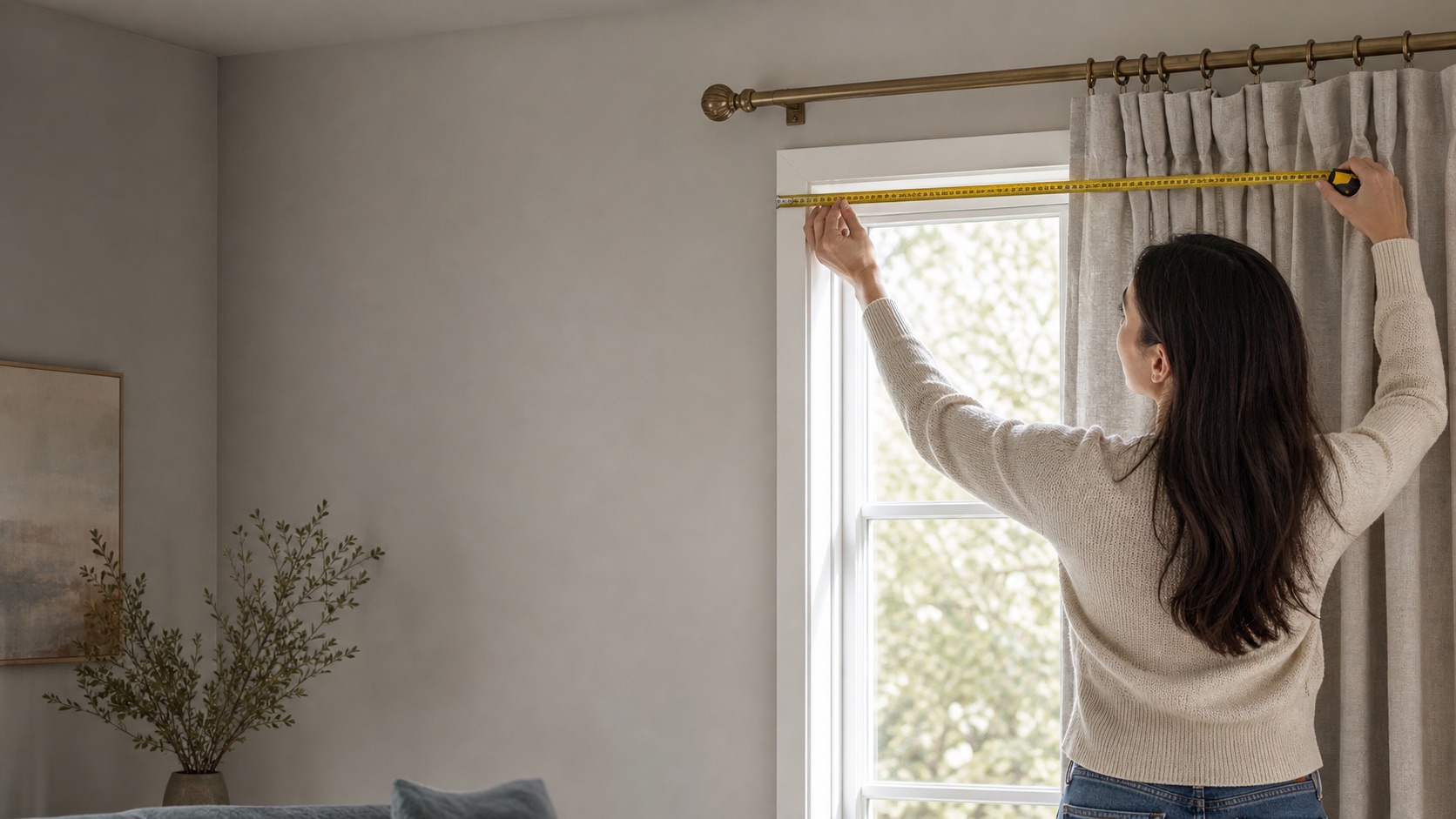
Good curtain sizing starts before you open a product page. The most useful measurements describe the real hanging system: the window opening, the rod or track span, the space where fabric can stack, and the distance from the hanging point to the floor. If one of those numbers is guessed, the curtain can still be technically the right size and look wrong in the room.
The goal is not to measure every surface in the room. The goal is to collect the few numbers that control the finished result. A professional installer will usually decide the hardware position first, then measure fabric width from the hardware, and only then choose the panel length. That order matters because curtains hang from rods, tracks, rings, hooks, or carriers, not from the glass itself.
Use the right starting point: window mode or rod mode
If there is no curtain rod or track yet, start with the window opening. Measure the visible window or the outside edge of the trim, then add room on both sides so the open curtains can stack away from the glass. This extra side space is often called stack-back. It helps daylight enter the room and makes the window look wider.
If the rod or track is already installed, measure the actual rod or track span instead. Do not add the same side extension a second time. A common mistake is measuring an installed rod, then adding another 8 or 10 inches per side because a guide mentioned side extension. That double-counts the stack-back and can lead to too many panels.
| Situation | Measure this | Why it matters |
|---|---|---|
| No rod or track yet | Window width plus planned side extension | You are deciding the hardware span and the fabric coverage together. |
| Rod already installed | Rod span between usable endpoints | The hardware already defines the space the curtain must cover. |
| Track already installed | Track span, including any overlap arm if the track uses one | The curtain travels along the track, so the track is the true width. |
| Inside-mount cafe curtain | Inside recess width and recess depth | The fabric must fit inside the frame without scraping the trim. |
Measure width with a metal tape and write down the exact number
Use a metal tape measure if you can. Soft sewing tapes can stretch or twist, and a half-inch error becomes more visible when you multiply the width for fullness. Measure in at least two places if the trim or wall looks uneven. For ordinary ready-made curtains, round the final buying decision up rather than down, but keep your raw measurement exact in your notes.
When planning a new outside-mounted rod, many retail and decorating guides recommend extending the rod beyond the window frame so the curtain can clear the glass when open. The exact extension depends on fabric thickness, window width, finials, and available wall space. Light sheers may need less stack room; lined blackout panels and wide pleats need more.
Measure length from the hanging point, not from memory
Length is where small assumptions create obvious problems. For a rod-pocket curtain, the panel may start near the top of the rod pocket. For rings or clips, the visible curtain starts below the ring. For hooks on a track, the heading may sit differently again. Measure from the point where the curtain fabric will actually begin to the place you want it to finish.
Floor-length curtains usually fall into four practical finishes. Hover stops slightly above the floor and is easiest to live with. Kiss just touches the floor and looks tailored when the floor is level. Break adds a little extra length so the fabric bends softly. Puddle is decorative and intentionally rests on the floor, but it collects dust and is less practical near doors, radiators, pets, or children.
| Finish | Typical adjustment | Best for |
|---|---|---|
| Hover | Stop about 0.5 in above floor | Bedrooms, rentals, daily-use curtains, uneven floors |
| Kiss | Land exactly at floor line | Tailored living rooms and calm bedrooms |
| Break | Add about 1 in | Soft formal rooms where fabric can rest lightly |
| Puddle | Add 3 to 6 in depending on look | Decorative rooms with low traffic |
Record the panel width exactly as the retailer lists it
Most curtain packages list width first and length second. A panel labeled 52 x 96 is 52 inches wide and 96 inches long when flat. That does not mean it will cover 52 inches on the rod after it is gathered. Once the curtain has fullness, a 52-inch panel may cover much less visual width.
Also check whether the listing is for one panel or a pair. Some retailers sell one panel at a time, while others sell a pair and describe the size of each individual panel. This is one of the easiest ways to underbuy or overbuy. If a pair contains two 52-inch panels, the flat fabric width is 104 inches total. If a single panel is 52 inches and you need two, you must buy two units.
A simple measuring example
Suppose your window trim is 60 inches wide and you have not installed hardware yet. You decide on 8 inches of stack-back per side because there is enough wall space. Your planned rod span is 76 inches. If you want standard 2.0x fullness, you need about 152 inches of flat fabric width across all panels. If each ready-made panel is 52 inches wide, three panels provide 156 inches flat, which is close and practical.
For length, suppose the rod-to-floor measurement is 96 inches and you want a kiss finish. A 96-inch panel may work if the hanging method does not lower the fabric below the measured point. If you are using rings or clips, measure again from the bottom of the ring or clip because the finished fabric may begin lower than the rod centerline.
If you are unsure which width to enter, use the curtain size calculator twice: once in window mode with your planned side extension, and once in rod mode with the exact rod span. The comparison will show whether your hardware plan is driving the panel count.
Common measuring checks before you buy
- Confirm the unit: inches and centimeters should not be mixed in the same calculation.
- Measure width from the same reference points on both sides: inside trim, outside trim, or rod endpoints.
- Check that finials and brackets do not make the rod visually longer than the usable curtain span.
- For tracks, include overlap only if the curtain actually travels through that overlap.
- For floor length, measure at the left, center, and right if the floor is not perfectly level.
- Keep product packaging terminology separate: panel width, pair width, and coverage width are not always the same thing.