
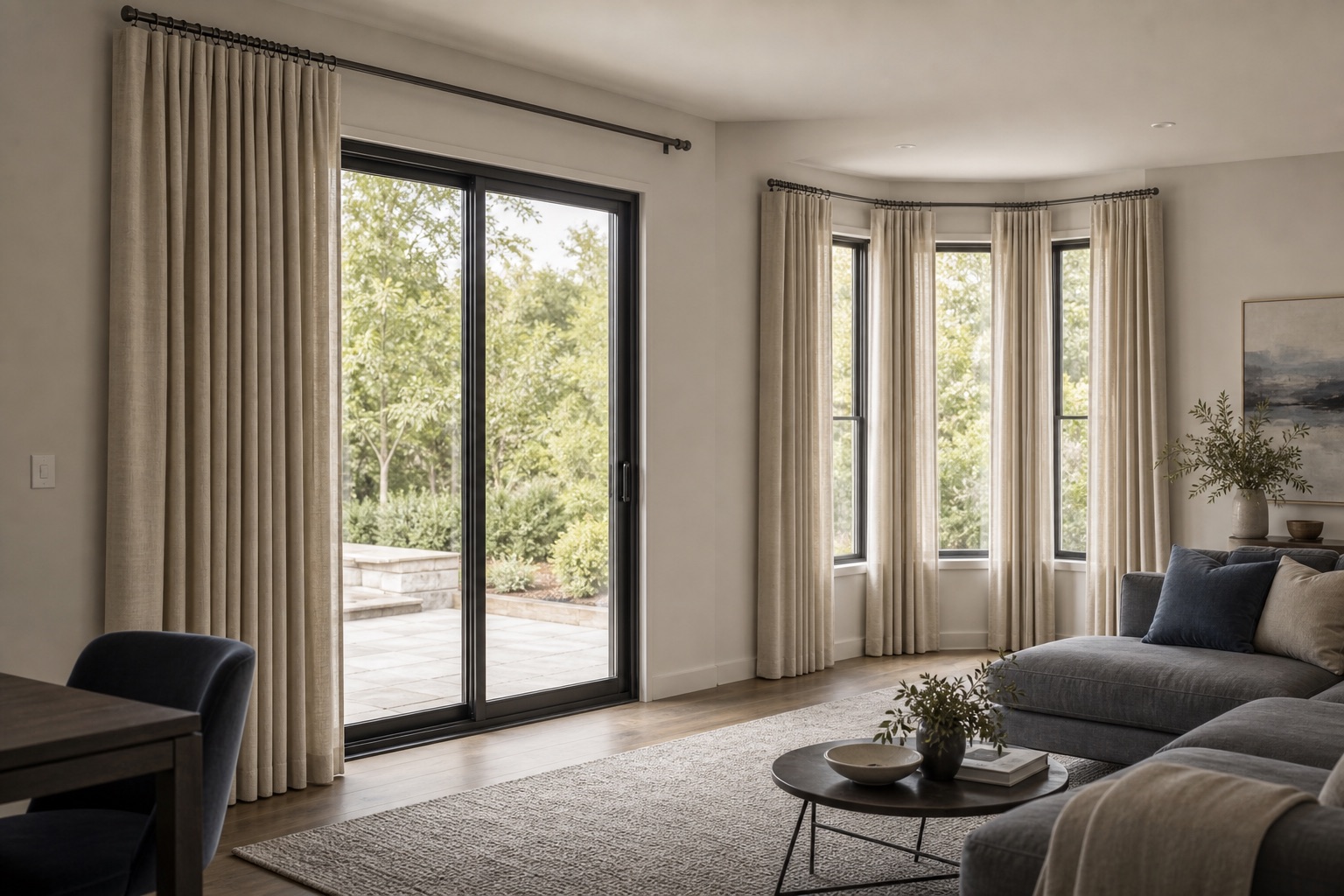
Corner windows create a meeting point where ordinary rods can collide and ordinary panels can leave a diagonal gap.
Measure each side clearly, then decide whether the curtains should meet, overlap, or operate as separate treatments.
Measure each wall side
Treat each window wall as its own span first. Record the width, available side space, and distance to the corner.
Plan the corner connection
Two finials may not fit in a tight corner. A corner connector, track, or simple separate rods can solve the hardware problem.
Add privacy overlap
If privacy matters, avoid a small diagonal gap where the two curtains meet. A little extra fabric near the corner can help.
Check stack direction
Curtains need somewhere to go when open. If both sides stack into the same corner, the fabric can become crowded and block light.
| Corner issue | Sizing response | Why |
|---|---|---|
| Finials collide | Use connector or track | Cleaner hardware |
| Diagonal gap | Add overlap | Better privacy |
| Crowded corner | Stack outward | More daylight |
| Separate windows | Calculate separately | Simpler panels |
How to map the hardware path
Special windows need a hardware map before they need a fabric number. For corner window curtain sizing guide, draw the path the curtain will actually follow: straight rod, angled bay track, corner connector, one-way draw, or grouped wall span. That path becomes the width reference.
Do not force an unusual window into a single-window formula too early. First decide where panels stack, where brackets interrupt movement, and whether the treatment behaves as one large span or several smaller sections. Then use the calculator on the correct span.
Example
Three narrow windows on one long rod should usually be measured as one grouped span, not three separate windows with stack-back added around each. A bay window with separate rods should be calculated by section. A continuous bay track should use the full track path.
Before you order
- Confirm whether the page or package size describes one panel or a pair.
- Keep inches and centimeters separate until the final conversion.
- Measure from the actual hanging point, not from the top of the window photo.
- Check whether brackets, finials, or corners limit how far panels can move.
The professional rule of thumb
A good curtain decision should pass three checks at the same time: it should cover the glass when closed, clear the glass when open, and finish at the floor or sill in a way that looks intentional. If one of those checks fails, the issue is usually not taste. It is usually width, fullness, hardware placement, or finished drop.
When two choices are close, choose the one that solves the harder problem. Width is usually easier to absorb because extra fabric becomes fullness. Length is harder because extra or missing fabric is visible at the floor. Hardware position is hardest to change after drilling, so confirm rod height, brackets, and side clearance before treating a package size as final.