
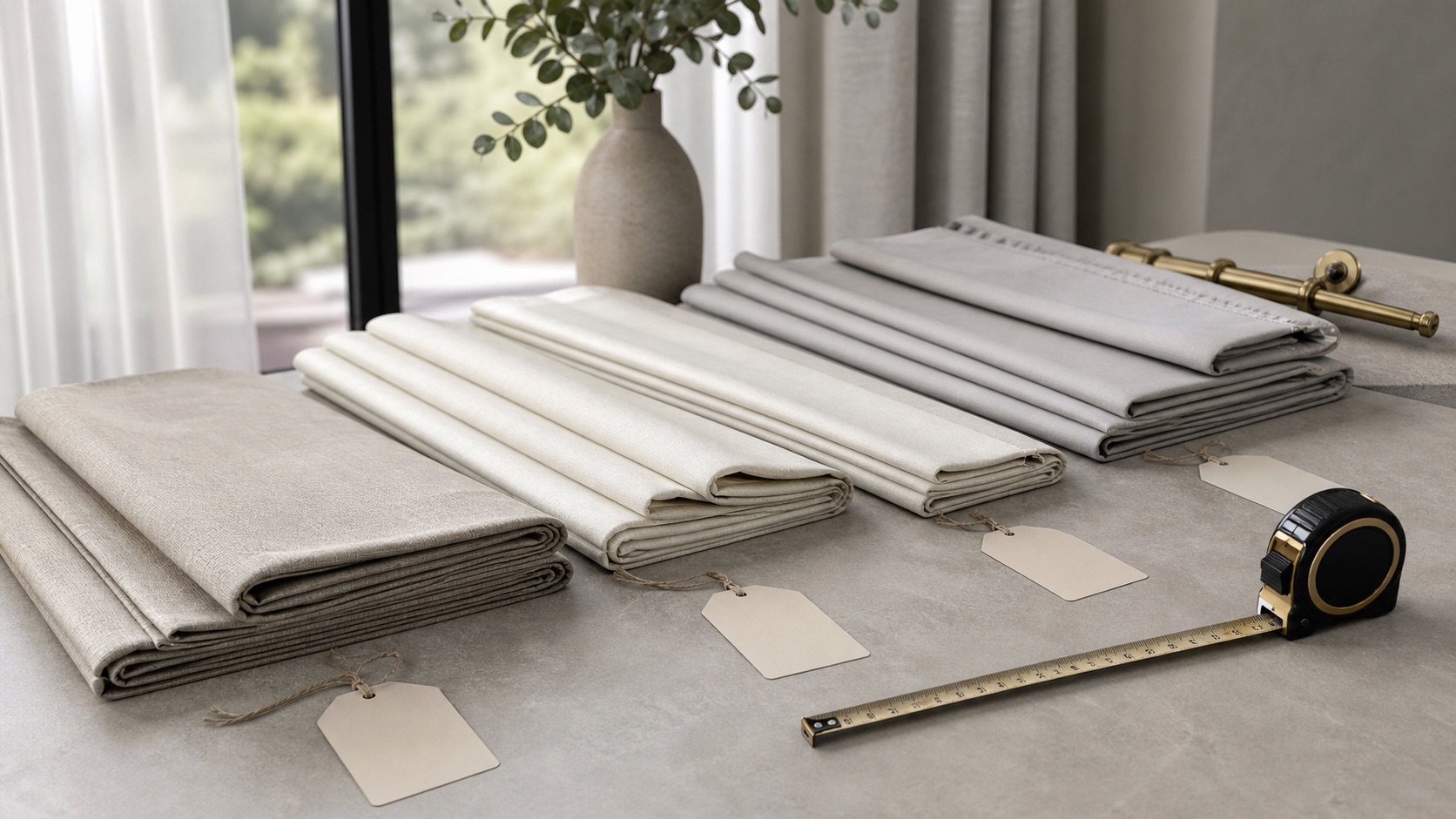
A curtain calculator gives you target numbers. A retailer gives you package sizes. The buying decision is the bridge between the two. Most frustration happens in that gap: the calculator recommends 152 inches of total fabric, but the store sells 50-inch or 52-inch panels; your drop is 95 inches, but the options are 84, 96, and 108.
The right answer is usually not a perfect match. Ready-made curtains work by choosing the closest practical width and length, then adjusting hardware, hemming, or fullness expectations. This guide explains how to make that decision without guessing.
Understand the label first
Most curtain sizes are written width by length. A 52 x 84 panel is 52 inches wide and 84 inches long when flat. The width describes the fabric before it is gathered. The length describes the finished drop of the panel, but the actual hanging height can still change depending on rings, clips, hooks, grommets, or rod pockets.
Some packages include one panel. Some include two. Always check the product description before multiplying. If the package contains a pair of 52-inch panels, you have 104 inches of flat fabric width. If the listing is for a single 52-inch panel, two units are needed to reach 104 inches.
| Label example | Usually means | Check before buying |
|---|---|---|
| 52 x 84 panel | One flat panel, 52 in wide and 84 in long | Whether the price is for one panel or a pair |
| Pair, each 50 x 96 | Two panels, each 50 in wide and 96 in long | Total flat width is 100 in, not 50 in |
| 100 x 84 set | Sometimes total pair width, sometimes one wide panel | Read the product details carefully |
Common ready-made lengths
Retailers vary, but many ready-made floor-length curtains cluster around 63, 84, 95 or 96, 108, and 120 inches. Shorter cafe and tier curtains use different sizes. Extra-long curtains may be available at 132 inches or beyond, but selection becomes narrower and custom work may be more realistic.
Do not choose length by ceiling height alone. Choose it from the hanging point to the desired finish. A room with an 8-foot ceiling can use 84-inch panels if the rod is low, 96-inch panels if the rod is mounted higher, or 108-inch panels if the hardware sits near the ceiling and the fabric is hemmed or allowed to break.
| Panel length | Typical use | Watch for |
|---|---|---|
| 63 in | Short windows, below-sill or apron-length treatments | Can look dated if used where floor length is expected |
| 84 in | Standard rooms with lower rod placement | May look short if the rod is mounted high |
| 95 or 96 in | Common floor-length option for 8 ft rooms with higher rods | Measure from the real hanging point, not the package photo |
| 108 in | Taller rooms, high-mounted rods, formal look | May need hemming if the room is not tall enough |
| 120 in | High ceilings and dramatic full-height treatments | Needs enough wall height and careful bracket placement |
When the calculated width falls between package sizes
For width, round up. Curtains that are slightly fuller usually look better than curtains that are too flat. If the calculator recommends 152 inches of flat fabric and the panels are 52 inches wide, three panels give you 156 inches. That is a good match. Two panels would only give 104 inches and would feel stretched across the rod.
The exception is very heavy fabric in a tight space. If four panels would crowd the window, block too much glass when open, or make the rod hard to use, a slightly lower fullness ratio may be more practical. This is why the calculator lets you change the fullness setting instead of forcing one standard number.
When the calculated length falls between package sizes
For length, the safer direction depends on the finish you want. If you want a hover finish, a panel that is too long will drag unless you mount the rod higher or hem it. If you want a break or puddle, a little extra length can be intentional. If you want a precise kiss finish, small errors are visible, so choose the closest length only after measuring the actual hanging point.
When the ideal finished length is 95 inches and the store sells 96-inch panels, the answer is usually easy. A ring, clip, washing shrinkage, floor unevenness, or a small hem can absorb the difference. When the ideal length is 90 inches and the choices are 84 or 96, 96 is often better if you can raise the rod or hem the panel. Choosing 84 may leave the curtain visibly short.
Two panels or four panels?
For a single standard window, two panels are often visually balanced: one left, one right. But the calculator may recommend three panels for width. In that case, you have a design choice. Three panels can work if one side uses two panels and the other uses one, but symmetry may suffer. Four panels may look more balanced, especially on a wide rod, but will increase fullness and stack-back.
For sliding doors and extra-wide windows, four panels are common because the span is wider and the fabric needs somewhere to stack. For small bedroom windows, four panels can be too bulky unless the fabric is sheer or the rod is wide enough.
A practical closest-fit workflow
- Use the curtain size calculator to find rod length, fabric width, panel count, and finished drop.
- Choose a likely ready-made panel width, such as 50 or 52 inches.
- Round panel count up to the next whole panel.
- Check whether the package is sold as one panel or a pair.
- Choose the closest length that supports your finish: hover, kiss, break, or puddle.
- If the closest length is not close enough, decide whether to move the rod, hem the panels, or choose a different product line.