
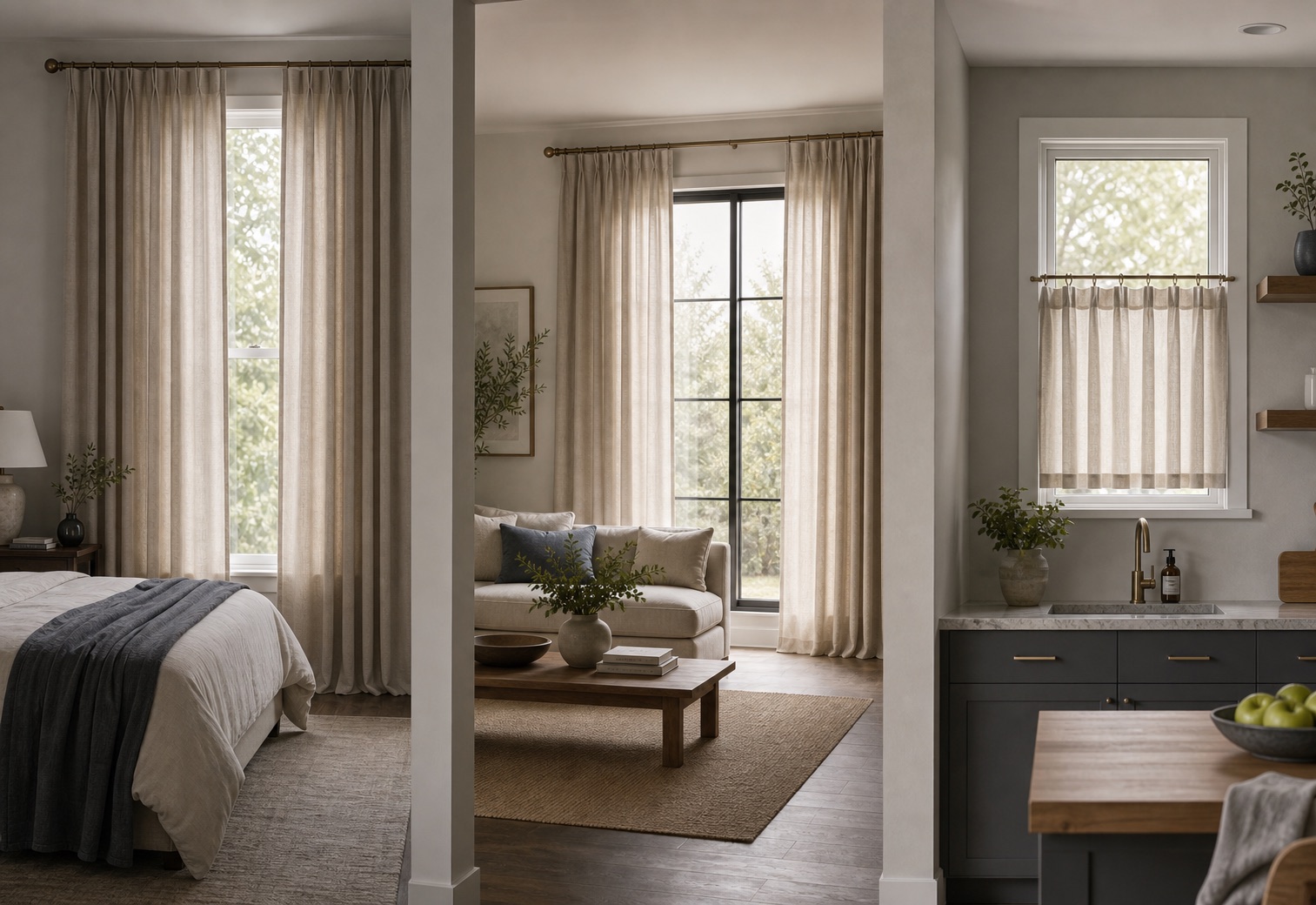
Living room curtains affect the architecture of the room. They can make windows look taller, soften hard walls, and control glare without making the space feel closed.
The best living room size is usually a little more generous than the bare minimum.
Mount high enough to improve proportion
A higher rod can make the wall feel taller and the window more intentional. Measure from the planned hanging point to the floor before choosing panel length.
Extend wide enough for daylight
Living rooms often need daytime light. A wider rod gives fabric space to stack beside the glass, keeping the window brighter when curtains are open.
Choose fullness for softness
Around 2x fullness works for many living rooms. Increase toward 2.5x for lightweight linen or sheers, and reduce slightly for heavy lined panels.
Pick a polished length
Kiss or slight break often looks best in living rooms. Hover is a practical option for high-traffic family spaces.
| Choice | Calm room | Formal room |
|---|---|---|
| Fullness | 2.0x | 2.3x to 2.5x |
| Length | Hover or kiss | Kiss or break |
| Rod placement | Above trim | Higher and wider |
| Fabric | Lined or light-filtering | Linen, velvet, or sheer layers |
How to apply this room by room
Room type changes the tolerance for mistakes. With living room curtain size guide, ask how the curtain will be used every day: opened often, closed for sleep, kept mostly decorative, or moved around doors and counters. That answer should guide fullness and finished length before you buy.
A practical room plan starts with function, then proportion. Bedrooms need privacy and light control. Living rooms need proportion and daylight. Kitchens need clearance. Rentals need hardware limits. After you know the priority, the calculator can help turn that priority into width, length, and panel count.
Example
A 60-inch window in a bedroom and a 60-inch window in a living room may not use the same curtain. The bedroom may need blackout coverage, center overlap, and a hover or kiss length. The living room may use a higher rod, wider extension, and a softer fullness ratio for visual height.
Before you order
- Confirm whether the page or package size describes one panel or a pair.
- Keep inches and centimeters separate until the final conversion.
- Measure from the actual hanging point, not from the top of the window photo.
- Check whether brackets, finials, or corners limit how far panels can move.
The professional rule of thumb
A good curtain decision should pass three checks at the same time: it should cover the glass when closed, clear the glass when open, and finish at the floor or sill in a way that looks intentional. If one of those checks fails, the issue is usually not taste. It is usually width, fullness, hardware placement, or finished drop.
When two choices are close, choose the one that solves the harder problem. Width is usually easier to absorb because extra fabric becomes fullness. Length is harder because extra or missing fabric is visible at the floor. Hardware position is hardest to change after drilling, so confirm rod height, brackets, and side clearance before treating a package size as final.