
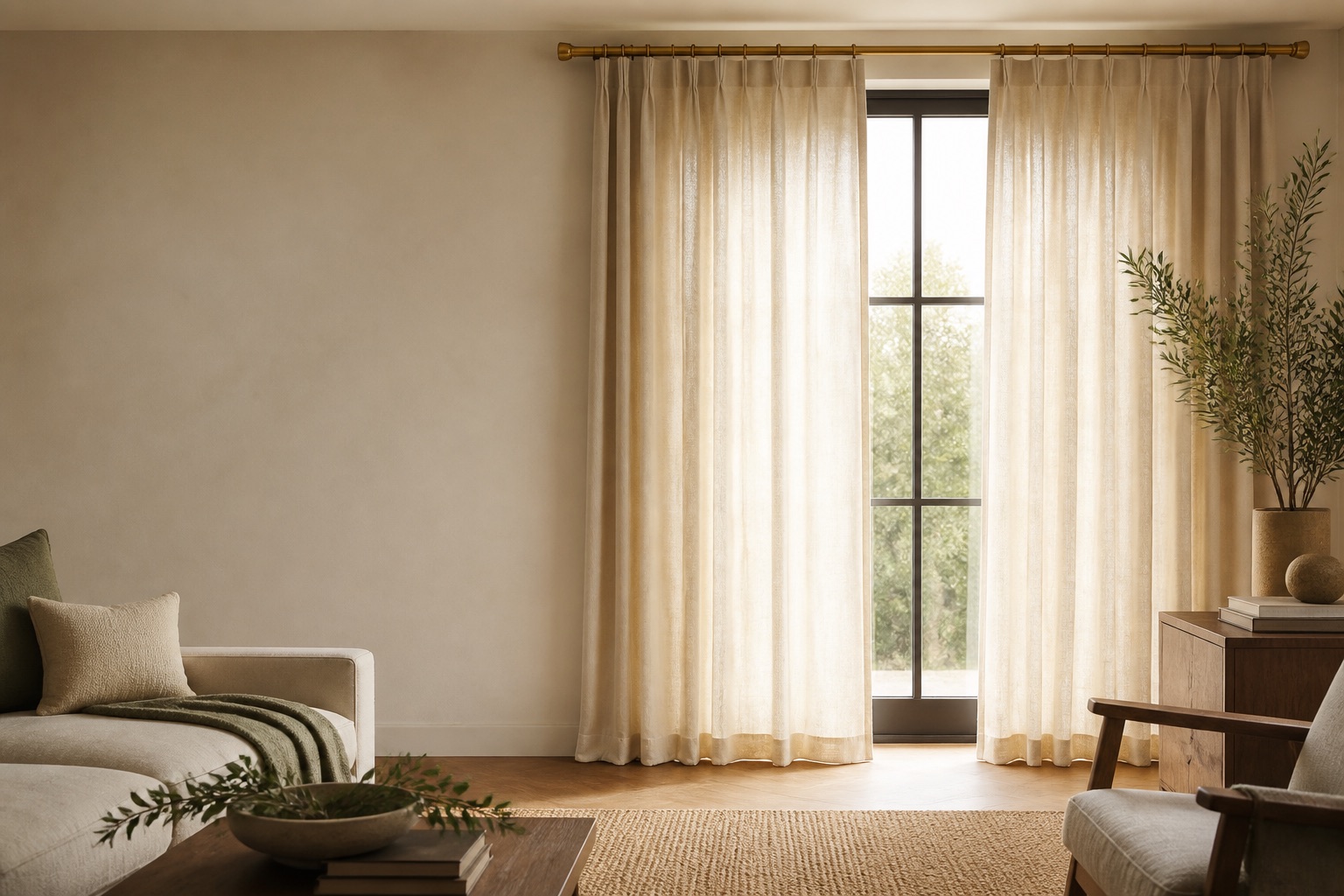
Rod length is more than window width plus a decorative endpoint. It decides where the fabric stacks, how much light remains visible, and whether the rod can support the panels.
A useful rod length calculation separates the usable rod span from finials and support hardware.
Stack-back creates open-window space
Stack-back is the space curtains occupy when open. Adding side extension lets fabric sit beside the glass instead of in front of it. Heavy or full curtains need more stack space than thin panels.
Brackets affect movement
A long rod may need a center bracket. Ordinary rings and grommets may not pass that bracket, so the curtain may open in two sections. Pass-through rings or tracks can change that limitation.
Finials are visual, not always usable
Finials add length visually but often do not provide travel space. When measuring usable rod width, focus on the area between stops where curtains can actually move.
Use rod mode for installed hardware
If the rod is installed, do not calculate from window width again. Measure the usable rod span and let the calculator apply fullness and panel count to that real number.
| Hardware part | Counts as coverage? | Why |
|---|---|---|
| Usable rod span | Yes | Curtains travel here |
| Finials | Usually no | Decorative end pieces |
| Center bracket | Depends | May block movement |
| Return section | Sometimes | Useful for blackout if fabric turns back |
How this changes the calculator inputs
This article explains one part of the calculator rather than a separate decorating rule. For rod length calculator guide: stack-back, brackets, and finials, the important habit is to keep the inputs separate: coverage width first, fullness second, panel width third, and finished drop last. When those numbers are mixed, the output can look precise but still be wrong.
The calculator is most useful when you test two realistic options. Compare a lower and higher fullness ratio, or compare a shorter and longer rod. The goal is not just to get one number, but to understand which decision changes the buying result.
Example
If a 72-inch rod is calculated at 1.5x fullness, the fabric target is 108 inches. At 2x fullness it becomes 144 inches. With 52-inch panels, both may still round to three panels, but the finished look will be different. That is why the visual and numeric result should be read together.
Before you order
- Confirm whether the page or package size describes one panel or a pair.
- Keep inches and centimeters separate until the final conversion.
- Measure from the actual hanging point, not from the top of the window photo.
- Check whether brackets, finials, or corners limit how far panels can move.
The professional rule of thumb
A good curtain decision should pass three checks at the same time: it should cover the glass when closed, clear the glass when open, and finish at the floor or sill in a way that looks intentional. If one of those checks fails, the issue is usually not taste. It is usually width, fullness, hardware placement, or finished drop.
When two choices are close, choose the one that solves the harder problem. Width is usually easier to absorb because extra fabric becomes fullness. Length is harder because extra or missing fabric is visible at the floor. Hardware position is hardest to change after drilling, so confirm rod height, brackets, and side clearance before treating a package size as final.