
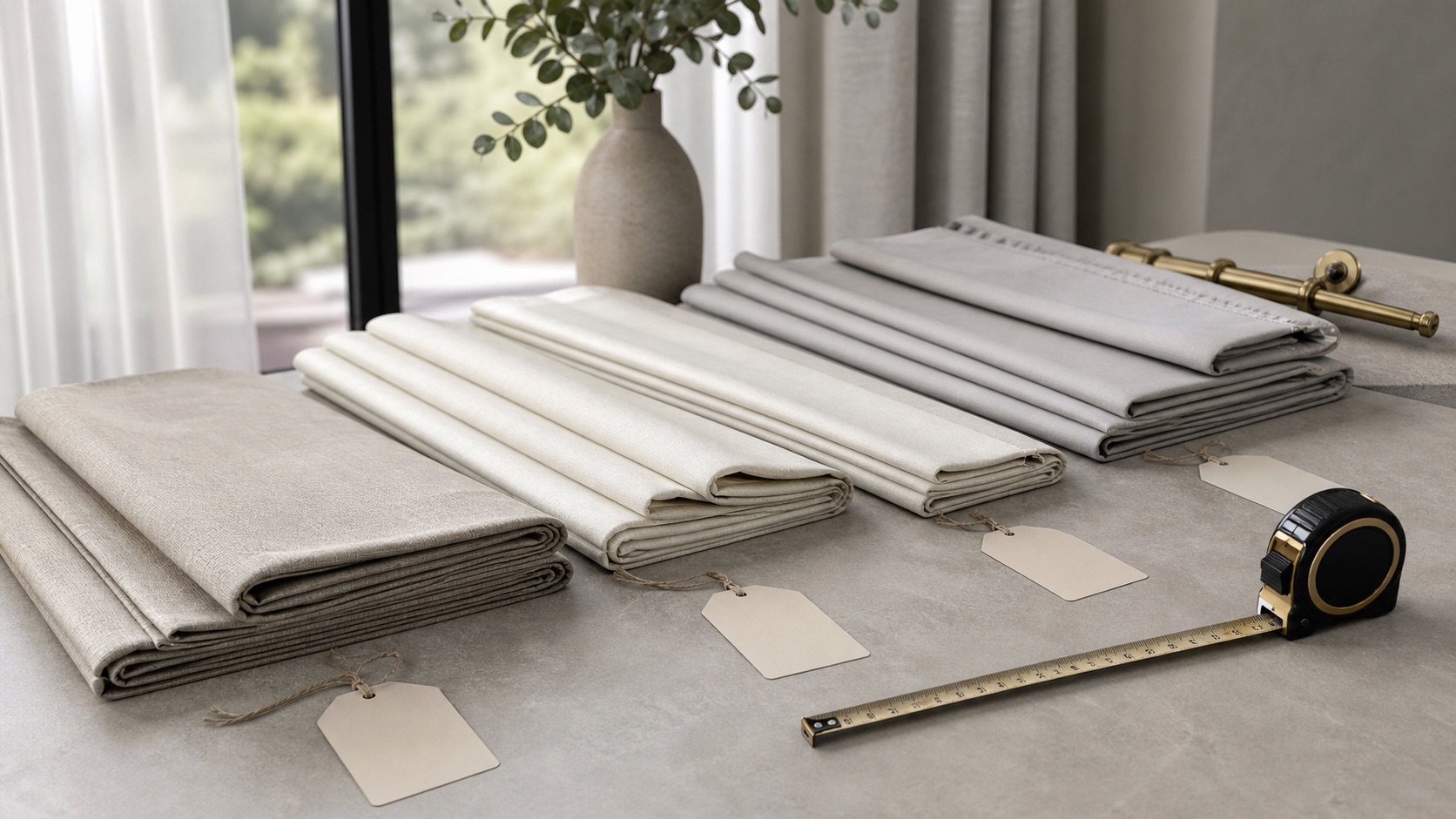
Ready-made curtain shopping often mixes inches, centimeters, and product labels. A quick reference helps you avoid unit mistakes before ordering.
Always confirm the retailer's exact size, but these common conversions are useful when comparing products across stores.
Common panel widths
Many single panels are around 50 to 54 inches wide, which is roughly 127 to 137 cm. Wider panels exist, especially for patio doors and custom-style ready-made lines.
Common panel lengths
Common lengths include 63, 84, 95 or 96, 108, and 120 inches. In centimeters, these are roughly 160, 213, 241/244, 274, and 305 cm.
Use centimeters carefully
Retailers may round conversions. A panel listed as 244 cm may correspond to 96 inches, but always check the exact product page if the floor finish is precise.
Convert the calculator result, not your memory
If you measured in inches, keep the calculation in inches until the end. If you measured in centimeters, stay in centimeters. Switching units mid-way is a common source of errors.
| Inches | Centimeters | Common use |
|---|---|---|
| 52 in wide | 132 cm | Common panel width |
| 84 in long | 213 cm | Standard length |
| 96 in long | 244 cm | Higher rod length |
| 108 in long | 274 cm | Tall look |
| 120 in long | 305 cm | High ceilings |
How this changes the buying decision
Use this guide after the calculator returns a target size. The question is no longer what the ideal measurement is; it is how to match common ready-made curtain sizes in inches and cm to real panels, real package counts, and real lengths sold by the retailer.
Ready-made curtains are a closest-fit product. Width can often be rounded up because extra fabric creates fullness. Length needs more care because extra fabric changes the floor finish. When in doubt, check whether the rod can move, whether hemming is acceptable, and whether the product is sold as one panel or a pair.
Example
If the calculator recommends 152 inches of flat fabric and the panel is 52 inches wide, three panels give 156 inches and are a clean match. If the drop is 91 inches and the store offers 84 or 96, the better answer depends on rod height and finish. For floor-length curtains, 96 with hemming or a higher rod often looks better than 84 that stops short.
Before you order
- Confirm whether the page or package size describes one panel or a pair.
- Keep inches and centimeters separate until the final conversion.
- Measure from the actual hanging point, not from the top of the window photo.
- Check whether brackets, finials, or corners limit how far panels can move.
The professional rule of thumb
A good curtain decision should pass three checks at the same time: it should cover the glass when closed, clear the glass when open, and finish at the floor or sill in a way that looks intentional. If one of those checks fails, the issue is usually not taste. It is usually width, fullness, hardware placement, or finished drop.
When two choices are close, choose the one that solves the harder problem. Width is usually easier to absorb because extra fabric becomes fullness. Length is harder because extra or missing fabric is visible at the floor. Hardware position is hardest to change after drilling, so confirm rod height, brackets, and side clearance before treating a package size as final.