
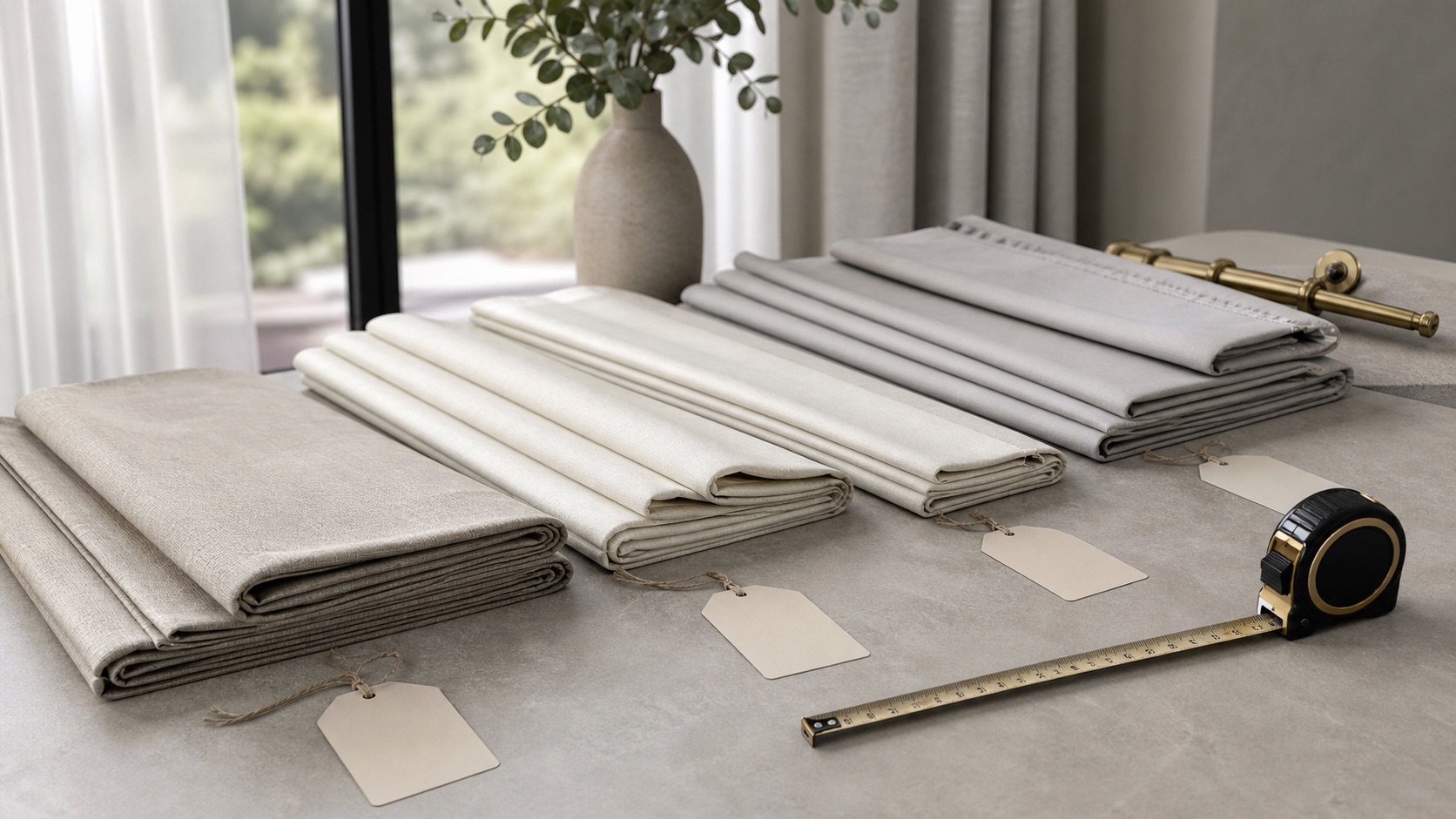
Curtain calculations rarely match store sizes perfectly. Rounding is normal, but width and length should not be rounded the same way.
The professional habit is to ask what the extra material will do in the room. Extra width creates fullness. Extra length changes the floor finish.
Round width up most of the time
If the fabric width target falls between panel counts, round up. Slightly more width usually looks fuller and closes better. Too little width makes panels look strained.
Be careful rounding length up
Extra length is visible at the floor. It can be useful for a break or puddle, but it can look messy if you wanted hover or kiss. If the extra is not intentional, plan to hem or raise the rod.
Do not round rod width without checking wall space
A wider rod can improve stack-back, but it may collide with corners, furniture, switches, or adjacent windows. Confirm the wall can hold the hardware.
Round panel count with package format in mind
If panels are sold in pairs, your real choices may be two, four, or six panels. Compare both the minimum and the next symmetrical option.
| Measurement | Usually round | Reason |
|---|---|---|
| Fabric width | Up | Fullness is forgiving |
| Panel count | Up | Panels are whole units |
| Finished length | Depends | Floor finish matters |
| Rod length | Only if wall allows | Hardware must fit |
How this changes the buying decision
Use this guide after the calculator returns a target size. The question is no longer what the ideal measurement is; it is how to match should you round curtain sizes up or down? to real panels, real package counts, and real lengths sold by the retailer.
Ready-made curtains are a closest-fit product. Width can often be rounded up because extra fabric creates fullness. Length needs more care because extra fabric changes the floor finish. When in doubt, check whether the rod can move, whether hemming is acceptable, and whether the product is sold as one panel or a pair.
Example
If the calculator recommends 152 inches of flat fabric and the panel is 52 inches wide, three panels give 156 inches and are a clean match. If the drop is 91 inches and the store offers 84 or 96, the better answer depends on rod height and finish. For floor-length curtains, 96 with hemming or a higher rod often looks better than 84 that stops short.
Before you order
- Confirm whether the page or package size describes one panel or a pair.
- Keep inches and centimeters separate until the final conversion.
- Measure from the actual hanging point, not from the top of the window photo.
- Check whether brackets, finials, or corners limit how far panels can move.
The professional rule of thumb
A good curtain decision should pass three checks at the same time: it should cover the glass when closed, clear the glass when open, and finish at the floor or sill in a way that looks intentional. If one of those checks fails, the issue is usually not taste. It is usually width, fullness, hardware placement, or finished drop.
When two choices are close, choose the one that solves the harder problem. Width is usually easier to absorb because extra fabric becomes fullness. Length is harder because extra or missing fabric is visible at the floor. Hardware position is hardest to change after drilling, so confirm rod height, brackets, and side clearance before treating a package size as final.